
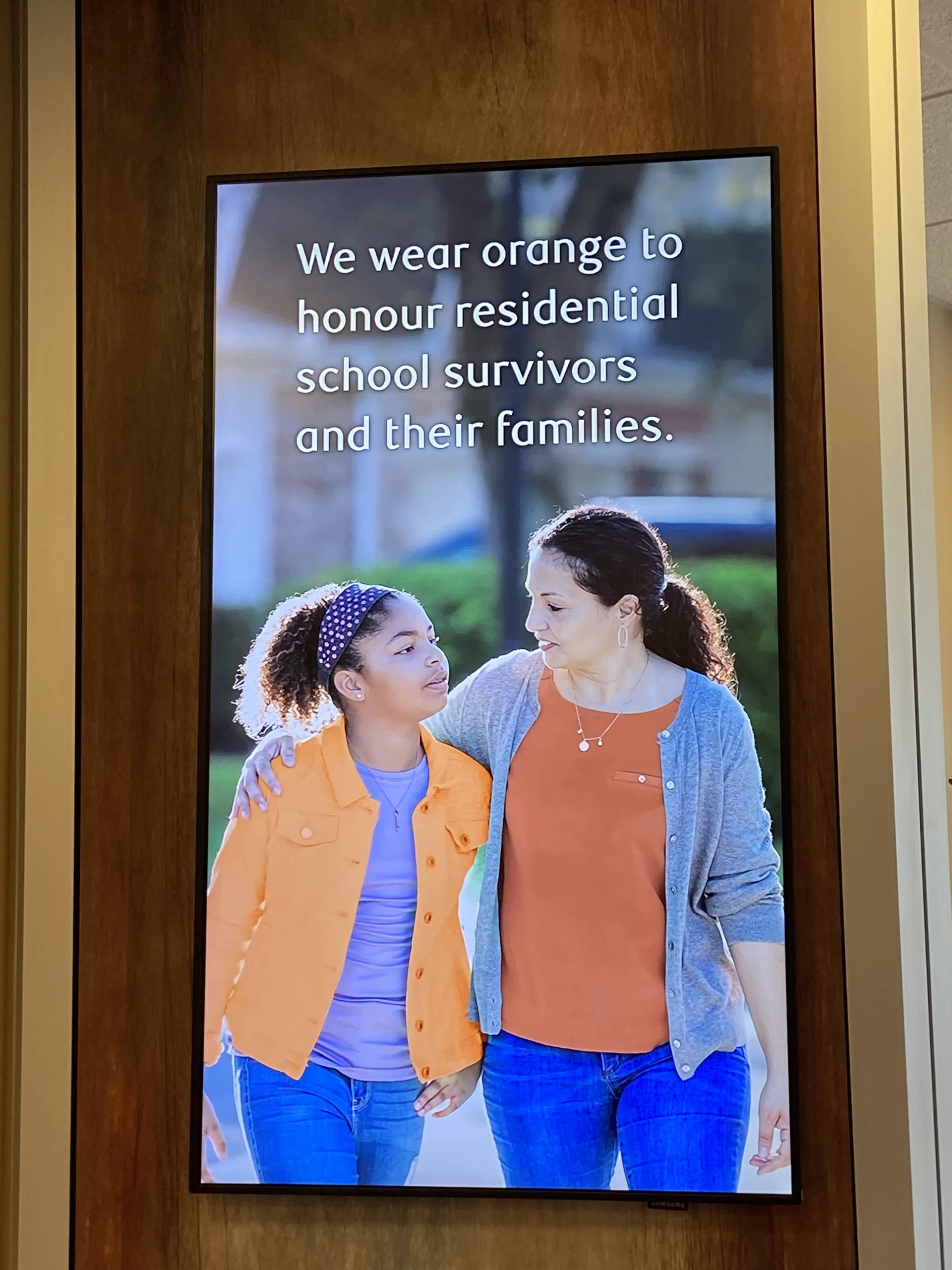
Content warning: This post discusses residential schools. Mental health support is available.
“Denialism is violence. Denialism is calculated. Denialism is harmful. Denialism is hate,” said Kimberly Murray, the Independent Special Interlocutor for Missing Children and Unmarked Graves and Burial Sites Associated with Indian Residential Schools. I wrote about what that denialism sounds like back in 2023. This September, it’s for sale.
In late August, Rebel News launched an “Orange Shirt Day” merchandise line: shirts reading “Dig Deeper,” “Still No Proof,” “Buried Truth,” and “Canada Was Built Not Stolen,” sized for adults and children alike. A promotional video accompanying the launch speculated that what investigators have found near former residential school sites (including at Kamloops) is more likely an old septic field than unmarked graves. Phyllis Webstad, who founded Orange Shirt Day in 2013 after her own orange shirt was taken from her on her first day at St. Joseph Mission residential school, called the youth sizing a new low and said plainly: survivors are not liars.
It’s worth naming exactly what this is, because denialists rarely announce themselves as such. As UBC literary scholar Daniel Heath Justice and University of Manitoba historian Sean Carleton define it, residential school denialism is the rejection or misrepresentation of basic facts about residential schooling to undermine truth and reconciliation, in ways that protect the status quo and the parties responsible for it. It doesn’t require denying the schools existed. It just requires chipping away at what happened inside them, one “just asking questions” at a time.
The Tactics, With This Year’s Storefront Attached
Justice and Carleton catalogued the recurring moves denialists make. A few of them are being printed on cotton right now.
Minimizing genocide. The Truth and Reconciliation Commission’s final report concluded that Canada’s residential school system constitutes cultural genocide, a finding the Canadian Historical Association has affirmed. “Canada Was Built Not Stolen” doesn’t contest the history so much as reframe the entire colonial project as something other than what it was: land, children, and culture taken, recast as foundation-building.
Demanding “proof,” on repeat. “Still No Proof” and “Dig Deeper” borrow the language of scientific rigor while ignoring the record that already exists: the National Centre for Truth and Reconciliation has documented more than 4,000 deaths of Indigenous children in the residential school system, a figure researchers widely regard as an undercount because so many deaths were never recorded at all. Ground-penetrating radar findings, survivor testimony, and church and government records aren’t absence of evidence. They’re evidence some would rather not sit with.
False balance. Ezra Levant, Rebel News’ founder, told CBC his outlet approaches the subject with compassion and is simply raising questions Canadians are no longer allowed to ask. This is the “balance” move Justice and Carleton warned about: treating the historical record and its politically motivated dismissal as two equally weighted sides of a debate, rather than as settled fact versus its erosion.
Casting Indigenous anger as the incivility. When Webstad and others objected, Rebel News’ response was to frame itself as the target, whether of cancellation, government overreach, or a media establishment policing speech. Justice and Carleton’s framework anticipated this too: survivors’ grief and anger get labelled as the uncivil thing, while the institutions and outlets provoking that grief get treated as reasonable.
Whose Proof Counts
There’s something worth sitting with underneath the “Still No Proof” slogan: our society’s near-religious attachment to the idea of proof, and how selectively that standard actually gets applied.
Ground-penetrating radar findings. The Truth and Reconciliation Commission’s six years of testimony from more than 6,500 witnesses. Federal and church records documenting the deaths themselves. Survivors telling their own stories, on the record, for decades. By any reasonable definition, that’s proof. Yet it keeps getting treated as provisional, pending some higher standard that’s never quite specified, while survivor testimony in particular gets held to a burden almost no other form of historical evidence is asked to clear. Philosopher Miranda Fricker named this pattern testimonial injustice: a speaker’s credibility gets discounted because of who they are, not because of what they’re saying. When the people being asked to “prove it” are the same people whose word was never trusted by the institutions that harmed them in the first place, the demand for proof isn’t a neutral evidentiary standard. It’s the same power relationship, just relocated to an argument about methodology.
And this selectivity isn’t unique to Canada. South of the border, RAND’s Truth Decay report has documented the same underlying shift: a blurring of the line between fact and opinion, where personal conviction increasingly outweighs verifiable evidence, especially when a claim flatters what people already want to believe. Repeated, well-documented falsehoods from public figures routinely get absorbed without much consequence, while thousands of documented residential school deaths, corroborated by radar, records, and testimony, still get met with “dig deeper.” The issue was never a genuine shortage of evidence. It’s that some claims get the benefit of the doubt by default, and others have to fight for it, again and again, no matter how much documentation accumulates.
Where It Went From Merchandise to Policy
The story didn’t stay a storefront controversy for long. Canada’s Liberal Indigenous Caucus called the shirts reprehensible. Six Liberal MPs, including Indigenous Services Minister Mandy Gull-Masty, Northern Affairs Minister Rebecca Chartrand, and Secretary of State Buckley Belanger, signed a letter urging a boycott of Rebel News’ advertisers. Webstad went further still, telling CBC she now supports adding residential school denialism to the Criminal Code as hate speech, and that she’d take that case to Ottawa herself. The Justice Minister’s office says any such law would need study first.
Rebel News has cast all of this as a coordinated attempt to criminalize dissent, pointing to federally funded research into a “trustworthy” news outlet directory as evidence of a broader speech-policing effort. Whatever one thinks of that framing, it’s a useful reminder of how denialism sustains itself: not just through individual claims about septic fields or unmarked graves, but through a ready-made narrative in which any pushback becomes proof of persecution.
What Combating This Actually Looks Like
Two things still matter most: education and coalition.
Education means going to the primary record (the TRC’s final report, the National Centre for Truth and Reconciliation’s findings, survivor testimony directly) rather than letting a slogan on a t-shirt set the terms of the conversation. Coalition means not leaving survivors and their families to answer denialism alone. The Liberal Indigenous Caucus statement and the advertiser boycott are one version of that; so is simply declining to treat “Still No Proof” as a serious question rather than a rehearsed tactic.
Orange Shirt Day exists to honour the children who were taken and the ones who never came home. It was never supposed to need defending from a t-shirt line.
Sources
- Daniel Heath Justice (UBC) and Sean Carleton (University of Manitoba), denialism framework, via UBC’s 8 Ways to Confront Residential School Denialism
- Truth and Reconciliation Commission of Canada, Final Report (2015)
- National Centre for Truth and Reconciliation, missing children records
- CBC News, “Orange Shirt Day founder says her truth is being ‘pushed aside’ by controversial shirts” (Sept. 2026)
- Rebel News / Ezra Levant, September 11, 2026 broadcast transcript
- Rebel News, “Orange Shirt Day founder wants to criminalize Rebel News t-shirts” (Sept. 13, 2026)
- Yahoo News Canada, “Orange Shirt Day founder says her truth is being ‘pushed aside’ by controversial shirts”
- Miranda Fricker, Epistemic Injustice: Power and the Ethics of Knowing (2007), on testimonial injustice
- Jennifer Kavanagh and Michael D. Rich, Truth Decay: An Initial Exploration of the Diminishing Role of Facts and Analysis in American Public Life, RAND Corporation (2018)